The moment an asset freezing decision is published in the Official Gazette, the clock starts ticking for every obliged party, from banks to jewellers. Assets belonging to the listed person or organisation must be frozen without delay and the situation reported to MASAK.
In this guide we explain what a freezing decision is, which laws it is based on, the routes through which decisions are taken and what obliged parties need to do step by step. We also focus on a risk that most screening approaches overlook: customers who are linked to a listed name not directly, but indirectly through shareholding and management ties.
What Asset Freezing Is, and What It Is Not
Asset freezing is the removal of a person’s or organisation’s power of disposal over their assets. The asset cannot be sold, transferred, withdrawn, pledged or used in any other transaction.
Freezing is not seizure or confiscation. Ownership does not pass to the state; it stays with the owner, and only the use of the asset is suspended. The measure does not depend on the outcome of an investigation; it remains in force until the decision is lifted.
The scope is broad: bank deposits, securities, crypto assets, real estate, vehicles, company shares and receivables all fall within the definition, along with every other economic value. Decisions can be lifted in the same way; for example, in the Official Gazette of 14 July 2026, the assets of 6 individuals and 3 organisations were frozen while, on the same day, the freezing decision concerning one individual was lifted (Ekotürk). Lists must therefore be tracked for removals as well as additions.
How Are Decisions Taken?
Freezing decisions come through three different routes, but all of them enter into force on the day they are published in the Official Gazette and have the same consequences for obliged parties.
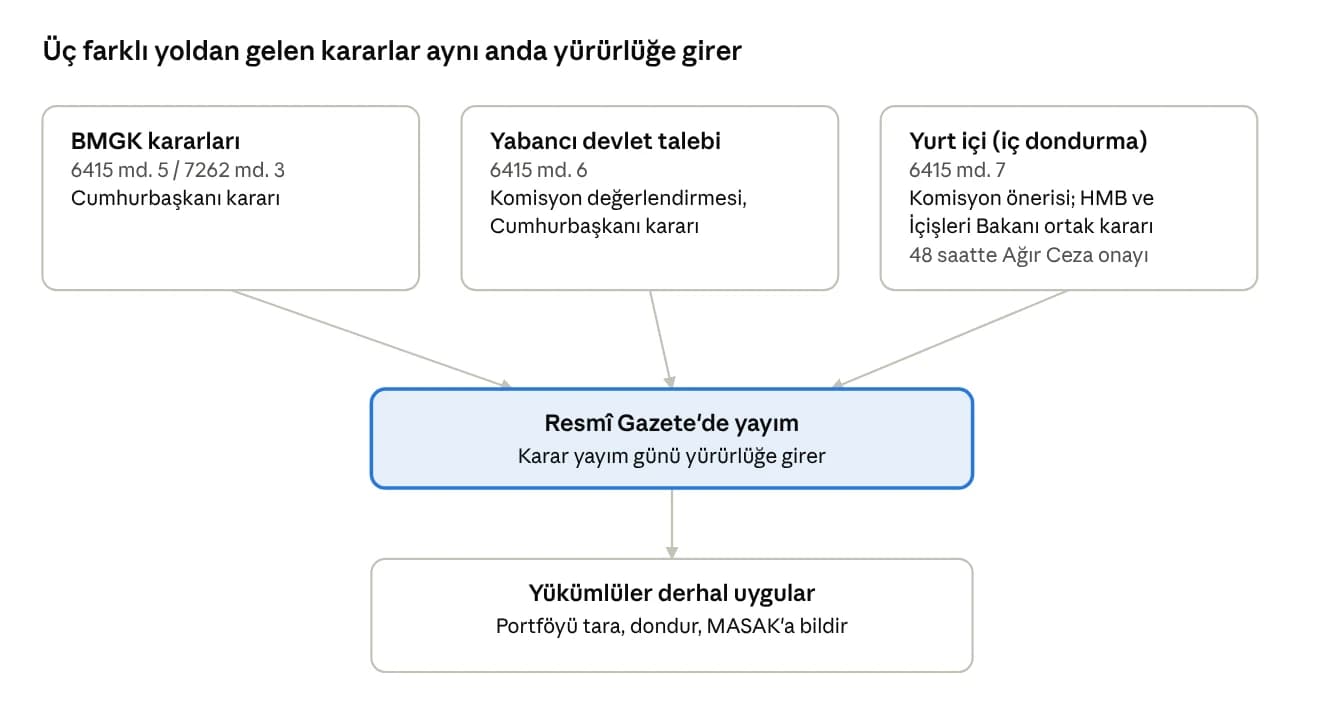
UN Security Council resolutions are implemented by Presidential decision under Law No. 6415 for terrorism lists and Law No. 7262 for weapons of mass destruction lists. Requests from foreign states are reviewed by the Asset Freezing Evaluation Commission and likewise take effect by Presidential decision. Domestic (“internal freezing”) decisions are taken jointly by the Minister of Treasury and Finance and the Minister of the Interior on the Commission’s proposal, and are submitted to the Ankara High Criminal Court for approval within 48 hours. For example, decision No. 2026/1, published in the Official Gazette of 14 July 2026, was taken through this route (Lexpera).
A recent development: A proposed legislative amendment made public in March 2026 envisages giving the Ministry of Treasury and Finance a temporary freezing power so that UN Security Council resolutions can be implemented within 24 hours; according to MASAK, the final decision will in all cases remain with the President (MASAK statement). Keep track of whether the amendment becomes law.
What Should Obliged Parties Do?
The decision enters into force on the day it is published in the Official Gazette and applies immediately to all obliged parties, including banks, payment and electronic money institutions, crypto asset service providers, brokerage firms, insurance companies, jewellers and real estate agents. FATF Recommendations 6 and 7 expect UN Security Council freezing decisions to be implemented within 24 hours (MASAK statement).
- Catch the publication. Monitor the Official Gazette every day, including repeated (mükerrer) issues; capture both new decisions and decisions lifting a freeze.
- Screen the entire portfolio. Run the new list not only against new customers but against all existing customers, beneficial owners, authorised representatives and transaction counterparties.
- Verify the match. Separate true from false positives using distinguishing details such as date of birth, nationality, ID and registry numbers; record the rationale for the decision.
- Freeze without delay. For a verified match, stop accounts, custody assets and pending transactions; watch out for the risk of tipping off the customer.
- Report to MASAK. Report the frozen assets using the procedure set by MASAK.
- Apply delistings. Lift the freeze for persons removed from the list; an unnecessary freeze also creates customer and legal risk.
A freezing notification is not an STR. Reporting frozen assets is a separate obligation under Laws No. 6415 and 7262. A suspicious transaction report, on the other hand, is assessed separately under Law No. 5549 where circumstances give rise to suspicion. A single match may require both; do not use one process in place of the other. See MASAK’s current guidance for the reporting procedure.
Why Name Screening Is Not Enough: Indirect Relationships
A freezing decision does not only cover accounts belonging to the listed name itself. The definitions under Law No. 6415 also target assets that the listed person or organisation owns or controls, directly or indirectly. In practice, the risk often lies not in the customer itself but in the relationships behind it.
Three typical scenarios that classic name screening cannot see:
- Shareholding link: The listed person holds shares in a limited company that is your customer; the company’s trade name does not appear on any list.
- Management link: The listed person is registered as the manager or authorised representative of the customer company.
- Chained structure: The listed organisation is an indirect shareholder of your customer through another company; the relationship only emerges two or three links down the chain.
In Turkey, these ties are largely recorded in Turkish Trade Registry Gazette announcements (incorporation, share transfers, manager appointments, address and capital changes). However, manually tracking this data and cross-checking it against a new freezing list is not realistic for a task that must be done on the day the list is published.
How to Build an Effective Screening Process
Effective screening rests on four components: an up-to-date list, accurate matching, a manageable alert volume and an auditable record.
| Component | What is needed | Common mistake |
|---|---|---|
| List tracking | Official Gazette freezing and delisting decisions, UN Security Council lists; OFAC, EU and UK lists according to the institution’s risk appetite | Monitoring only Law 6415 lists and missing Law 7262 decisions |
| Screening timing | Instant screening at onboarding, rescreening the entire portfolio whenever a list is updated | Screening existing customers only during periodic reviews |
| Matching | Algorithms that recognise Turkish characters (ç, ğ, ı, ö, ş, ü), transliteration, aliases and word-order changes | Exact matching that misses differences such as “ŞİŞLİ” vs “SISLI” |
| Alert management | Secondary verification with date of birth, nationality, ID and registry number; risk-based prioritisation | Reviewing every alert manually with the same priority |
| Audit trail | A time-stamped, immutable record of every screening, alert and decision | Keeping decisions scattered across email and Excel |
The international lists each institution covers should be determined on a risk basis, according to its line of business and counterparty profile.
Catch Freezing Decisions with Datactive and DataSentinel
Used together, Datateam’s two products make both direct and indirect matches visible on the day a list is published.
Datactive Sanctions & PEP Screening screens customers and transaction parties against sanctions, PEP and adverse media sources:
- Brings freezing and delisting decisions published in the Official Gazette under Laws No. 6415 and 7262 together with international lists in a single dataset.
- Automatically rescreens the entire portfolio when a list is updated, and screens instantly at onboarding.
- Reduces false positives with matching suited to Turkish name structures and transliteration.
- Records every alert and decision with a time stamp, showing auditors when, what and why something was done.
DataSentinel is a corporate relationship and risk analysis platform built on Turkish Trade Registry Gazette data:
- Reveals the companies in which a listed person is a shareholder, manager or authorised representative.
- Makes indirect relationships visible by following ownership chains between companies.
- Tracks registry events such as share transfers and management changes, showing how risk evolves throughout the customer relationship.
Used together, the question shifts from “Is this name on the list?” to “Is there someone on the list behind this customer?” Explore the Datactive Sanctions & PEP Screening and DataSentinel product pages, or request a demo from Datateam.
Frequently Asked Questions
What is the difference between asset freezing and seizure?
With freezing, ownership stays with the owner and only the power of disposal is removed. With seizure and confiscation, the asset leaves the owner’s control.
When does a freezing decision enter into force?
On the date it is published in the Official Gazette. Obliged parties must apply the decision without delay.
Can a freezing decision be lifted?
Yes. Decisions end with delisting decisions, which are also published in the Official Gazette. Those concerned can request delisting, and decisions are subject to judicial review.
Do existing customers also need to be screened?
Yes. A customer may be added to a list after the relationship has begun. The entire portfolio should be rescreened with every new decision.
My customer is not on the list but its shareholder is; what should I do?
The listed person’s shareholding in or control over the customer may fall within the scope of the freeze. Assess the situation with your compliance unit and consult MASAK if necessary.
This content has been prepared for general information purposes. The obligations and freezing decisions applicable to your institution should be assessed against current legislation by authorised legal/compliance teams.